


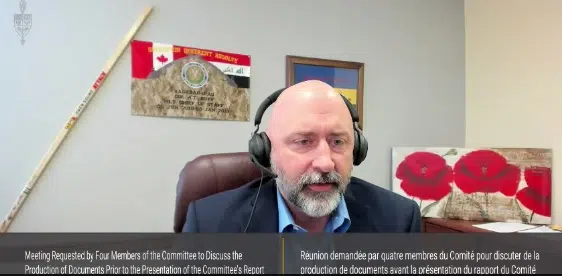
A vote on a motion requesting the federal government release reviews by its departments on the evacuation of Kabul in 2021 could be held later today.
Bruce-Grey-Owen Sound Conservative MP Alex Ruff made the motion, which was debated at the Special Committee on Afghanistan’s meeting last Wednesday afternoon.
The motion asks a number of government departments, (the Privy Council Office, Global Affairs Canada and The Canadian Armed Forces and any others) to provide the Afghanistan Committee with already existing draft or completed reviews so they can be included in the committee’s final report to the government on June 8.
Liberal committee member Pam Damoff suggested an amendment proposing the requested reviews be released to the National Security and Intelligence Committee of Parliamentarians (NSICOP) for assessment before a decision is made about whether they should go to the Afghanistan Committee.
NSICOP was created in 2017. Its members hold top secret security clearances. The committee currently has members from the Liberal Party, NDP and Conservative Party as well as some senators. It reviews national security and intelligence policy and actions.
Damoff cited concerns the reviews would contain sensitive information about national security. “I think it’s important to recognize that this isn’t sloughing it off, that NSICOP is there for a valid reason. This is the right place,” said Damoff.
She was supported by Liberal colleague Yvan Baker.
While Ruff sits on both committees, he noted he could not support Damoff’s amendment, saying he has been ‘part of the pen’ of many department reviews with the Canadian Armed Forces, noting documents reviewing actual operations are normally classified paragraph by paragraph.
Ruff said he expects some part of the documents to be redacted if they affect national security, though he feels the majority of it should not be redacted.
“These reports do need to come to this committee,” said Ruff, adding, “This is part of our mandate. The motion that created the Special Committee on Afghanistan was to look in, and look back at what went wrong, what went right, how can we learn from it to make sure we don’t make these mistakes going into the future.”
Ruff referred to a United Kingdom report released May 24 that he described as “very damning” and noted in the meeting he expects Canada’s report will find, “very similar conclusions based on what we’ve heard to date, and that may be contained in these reports.”
Wellington-Halton Hills Conservative MP Michael Chong also opposed Damoff’s amendment, saying, “I think giving these documents to an extra-parliamentary committee is completely unacceptable.”
He explained, NSICOP is not a parliamentary committee, it is a committee of parliamentarians, the difference being that NSICOP is accountable to the Prime Minister’s Office rather than the House of Commons. “Its members serve at the pleasure of the Prime Minister,” said Chong.
Chong added, parliament needs information to do its work, and the work is part of the public record.
Vancouver East NDP MP Jenny Kwan expressed concern about the release of sensitive information and requested more information about the reviews, saying if it is determined they contain information that could be a risk to Canada’s security, then NSICOP should get the documents, but if there is no risk, then the Afghanistan committee should get them.
Last Tuesday, the University of Ottawa’s Graduate School of Public and International Affairs national security task force published a report called A National Security Strategy For The 2020s.
It is written by four former National Security Advisors to the Prime Minister as well as a former Canadian Security and Intelligence Service (CSIS) director, former ambassadors and top civil servants.
The overall argument made in the report is that Canada needs to update its national security and intelligence policies.
It says Canada’s traditional approach to national security is no longer sustainable.
One recommendation in the report states, “Use the upcoming five-year review of legislation governing the National Security and Intelligence Committee of Parliamentarians to consider making it a parliamentary committee, as opposed to a committee of parliamentarians, the current construct. This would align it with the UK Intelligence and Security Committee, which reports to parliament and not to the British prime minister. It would also remove any suspicion that the government somehow unduly influences the committee’s work.”
The matter of which committee will get the reviews of actions during the fall of Kabul will be revisited at this evening’s meeting of the Special Committee on Afghanistan.