


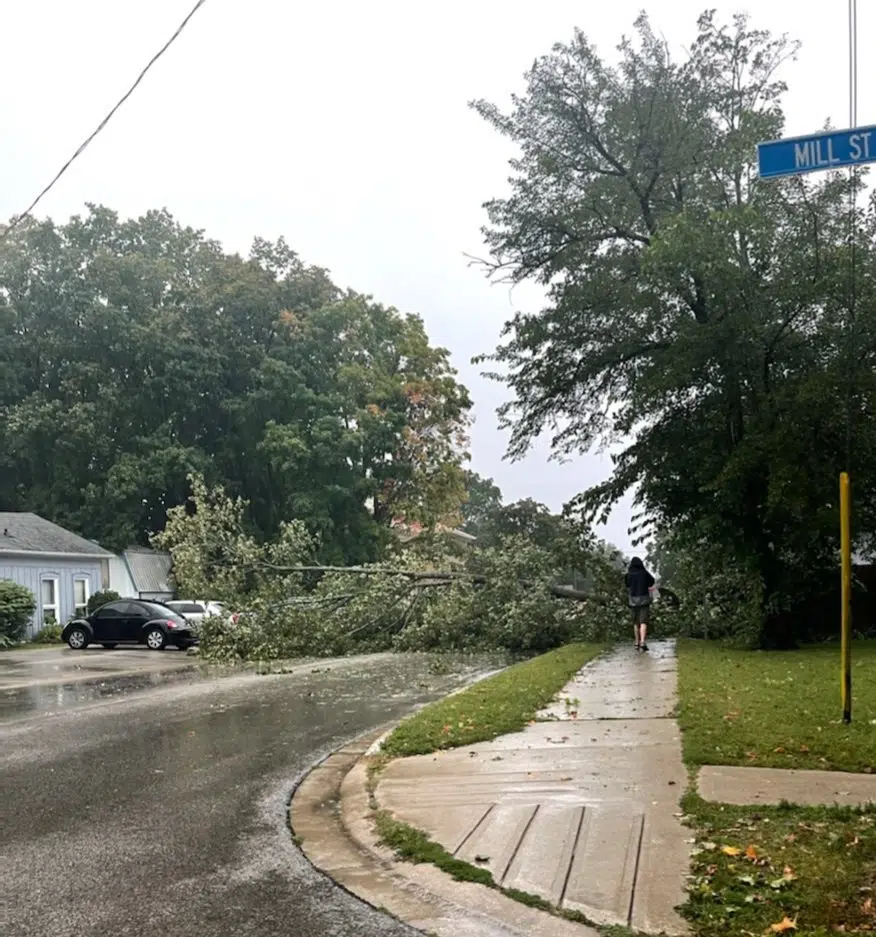
An image of storm damage from Sept. 7, 2021 in Port Elgin. (Saugeen Shores Police Twitter)
An organization that documents tornadoes in Canada has completed its preliminary assessment of the severe storm that hit Bruce and Grey counties last week.
The Northern Tornadoes Project says an embedded supercell developed over Lake Huron as a result of a fast-moving line of storms overtaking a smaller, slower moving line. The group says the supercell generated a multi-vortex tornado, as well as several other smaller tornadoes and downbursts as it came ashore.
The organization confirms a twister touched down in the Kingsbridge area and tracked towards Lucknow. It says “significant tree and structural damage” was reported. The Northern Tornadoes Project says a preliminary review of ground and drone survey data finds at least one tornado path with a preliminary EF2 rating. The twister near Lucknow had maximum wind speeds of up to 180 km/h, a path width of around 1.3 km and a track length of nearly 19 km.
According to the Northern Tornadoes Project, the same supercell re-intensified as it approached Harriston and generated a second tornado that extended to Kenilworth. The second twister was rated as an EF1.
The same line of storms also generated an EF0 tornado near Goderich.
Meanwhile, the severe weather that hit the Saugeen Shores area was determined to be a series of downbursts.
The Northern Tornadoes Project says a “bow echo” in the line of storms over Lake Huron produced downbursts as it came ashore at Port Elgin and at Southampton around 4:30 p.m. on Tuesday, Sept. 7. The organization says the damage from these downbursts was rated at EF1 and EF0.
The Sept. 7 storm caused extensive tree and structural damage in several Bruce County communities, while knocking out power to thousands of hydro customers in the region.
The Northern Tornadoes Project, which aims to detect and document all tornadoes in Canada, was founded in 2017 by Western University and ImpactWX.
A fast-moving line of storms overtook a smaller, slower moving line resulting in the development of an embedded supercell over Lake Huron. The supercell generated a multi-vortex tornado, plus several weaker ‘satellite’ tornadoes and downbursts, as it came onshore. #ONStorm 2/n pic.twitter.com/ozOS16BfMB
— Northern Tornadoes Project 🇨🇦 (@westernuNTP) September 10, 2021