


The United Way of Bruce Grey says that the minimum income required for the region has gone up again.
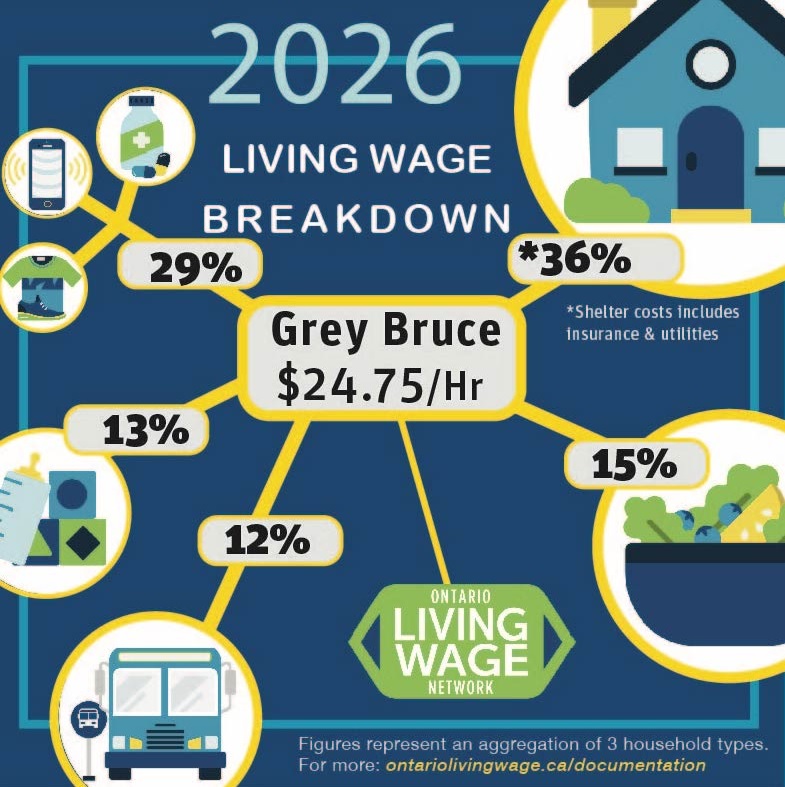
In a media release, the organization says that the Ontario Living Wage Network has announced the the living wage for Bruce and Grey has increased to $24.75.
That’s up slightly from $24.50 in 2025.
United Way Executive Director Francesca Dobbyn explained why the region has the second highest living wage in the province.
“It’s only risen a little bit this year, because some things have settled down in terms of inflation, but it is so significantly higher than minimum wage,” she said. “We are the second-highest in the province around a living wage, which we have been consistently since the living wage started to be measured at a provincial level.”
The current minimum wage for Ontario just increased as of October 1st, to $17.95 per hour, which .
This means that in order to be able to afford the necessities, including rent and food, more than one full-time income is usually necessary.
Looking across the province, only the Greater Toronto Area has a higher living wage, at $27.60.
Dobbyn said that it’s probably due to a lack of public transportation.
“I think the biggest piece for use is a lack of transportation,” Dobbyn suggested. “When we do the calculation, in urban centres, the calculation gives the household one car and then a transit pass. We do not have any transit that is reliable enough and robust enough throughout Bruce and Grey, because the City of Owen Sound does have six day a week transit, but we don’t have a robust enough system in the rest of the region, especially for employment. So in our calculations, our households always get two cars if there’s two adults in the family, because that’s how they maintain a job.”
Aside form transportation, high rental costs are also to blame, which stem from both lack of inventory and higher prices overall.
“Part of why we do this is to educate the community that those that are struggling are struggling because of an income issue. It’s not a budgeting issue. We hear it all the time when we talk about people struggling with utilities or struggling to access food is “Well, they just need to learn to budget better,’ and no amount of budgeting will allow you to take $1,300 worth of ODSP to pay $1,500 worth of rent,” added Dobbyn. “And it’s simply a case of not enough income, and what the living wage does is it provides the budget that ‘this is the standard household budget’ based on data that comes from other sources. So Public Health around the cost of food, the CMHC for the cost of housing, all of those other pieces.”
Given the factors that are measured in order to calculate the living wage, vacations, savings, and big entertainment costs aren’t factored in.
“There’s minimal recreation in the calculation for living wage. There’s certainly no savings, there’s no vacation, there’s none of the fun stuff in this budget. This is a bare bones budget.”
The breakdown of living costs includes:
• 36% for shelter, including insurance and utilities
• 29% for other household necessities and expenses
• 15% for food
• 13% for childcare
• 12% for transportation
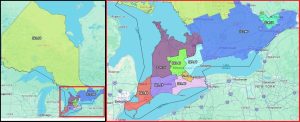
A map of the area including Bruce and Grey counties compared to the rest of Ontario. (Images via The Ontario Living Wage Network)