


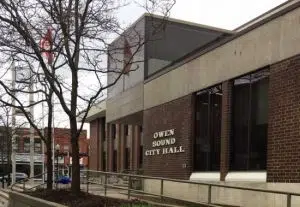
Owen Sound City Hall. (photo by Matt Hermiz/Bayshore Broadcasting)
The City of Owen Sound is opposing the province’s proposed consolidation of conservation authorities.
Council passed several recommendations during a Dec. 15 special meeting relating to Bill 68, The Plan to Protect Ontario Act, resolving to call on the Ontario government to “maintain local, independent, municipally governed, watershed-based conservation authorities to ensure strong local representation in decisions.”
Bill 68 received received Royal Assent in November. It amends the Conservation Authorities Act to establish a new Ontario Provincial Conservation Agency, and also proposes to reduce the number of local conservation authorities through mergers. The new provincial agency will also able to issue direction to the regional conservation authorities.
The province’s public comment process on the proposed changes for conservation authorities closed on Monday (Dec. 22).
Currently, Owen Sound is one of eight member municipalities in the Grey Sauble Conservation Authority watershed jurisdiction. If the province moves ahead with its proposed changes, Owen Sound would become one of 80 municipalities in a newly established Huron-Superior Regional Conservation Authority, which would cover more than 23,500 square kilometres and stretch from Grand Bend to Thunder Bay.
The resolution passed by Owen Sound council formally opposes the establishment of the Huron Superior Regional Conservation Authority, over concerns of diminished local governance and a “(failure) to recognize the effectiveness and efficiencies already achieved within existing watershed-based models.”
“The existing watershed-based boundaries should be maintained,” a report by Owen Sound’s Senior Planner Margaret Potter says.
The Blue Mountains, Arran-Elderslie, Chatsworth, Georgian Bluffs, Grey Highlands, Meaford and South Bruce Peninsula are also part of the Grey Sauble Conservation watershed.
“Sentiment from all councils is this does not seem like a good idea for rural Ontario,” says Grey Sauble Conservation Authority Chief Administrative Officer Tim Lanthier.
Lanthier spoke to Owen Sound councillors and told them the new process proposed by the provincial government “should cost more.”
“The reason I say that is we’re adding extra levels of bureaucracy. We the province saying ‘no jobs will be lost by this.’ So your opportunity within amalgamation to save money through that type of cut, is not going to exist,” Lanthier explains. “We have the province saying ‘local offices are expected to remain open.’ So you still have the operating costs associated with those offices.”
“You’re now also paying for a regional governance body … there’s also a provincial conservation agency,” Lanthier continues. “The (legislation) states the provincial conservation agency can apportion their costs to conservation authorities.”
He says Grey Sauble Conservation generates about 50 per cent of the revenue which supports its budget, while municipal levies cover about 43 per cent. Provincial funding makes up the remaining seven per cent of the Grey Sauble Conservation budget.
Lanthier says parking revenue from some of its popular tourist properties — such as Inglis Falls, Hibou Conservation Area and others — will generate about $400,000 in revenue this year. But he is concerned those dollars could be funnelled elsewhere under the new regional structure in the province, rather than being reinvested locally for capital improvements to conservation authority properties.
“We have no guarantees that money ever comes back to the community. I have concerns there as well,” Lanthier says.