


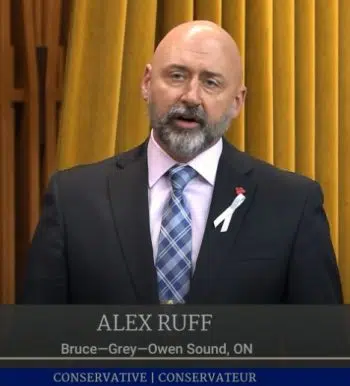
Bruce-Grey-Owen Sound Conservative MP Alex Ruff is describing the new federal Liberal-NDP Supply and Confidence deal as ‘ridiculous.’ He’s concerned more bills will now become confidence votes and debate will be curtailed.
“It’s going to basically remove accountability from any of the legislation and discussions that we do, and transparency,” says Ruff, adding, “There are some things in there that don’t make any sense. The NDP are basically foregoing their responsibilities as an opposition party. They’ve come in and they’ve basically made this pact that they’re going to support and prop up the Liberals for the next three years. If that’s what they wanted to do, why wouldn’t they have announced that before the federal election?” says Ruff.
“De facto, the NDP are now part of the Liberal government,” says Ruff.
On Tuesday, the Government announced it had made a deal with the NDP which involves the New Democrats supporting the Liberal Government until June 2025 in exchange for the Liberal Government’s prioritization of the NDP’s platform programs of dental care for children, seniors, low income Canadians and those with disabilities. The Liberals are also committing to advancing the NDP’s plan for a national Pharmacare program among other policy priorities. The deal is not considered a coalition agreement which would have involved NDP members gaining cabinet seats.
NDP Leader Jagmeet Singh said Tuesday in an announcement, “This is not at all a carte blanche. We will remain an opposition party. We will continue putting questions to the government, we will vote against things.” Singh also noted the NDP has the option of withdrawing from the agreement.
But Ruff says,”It undermines, in my opinion, all the accountability and transparency that goes on.”
Ruff brings up the issue of time allocation which is described in the government’s announcement as, “The NDP will support a limited number of programming motions to pass legislation that both parties agree to.”
Ruff says, “Which is their ability to stop our ability to do any sort of proper scrutiny over certain bills that are priority for them, so the debate doesn’t occur. It will take away that ability for MPs to have the privilege of debate.”
Ruff says programming motions allocate only a certain number of hours left to debate a bill. He is concerned it will cut off debate, because it would limit the amount of time MPs can spend talking about a bill, and can ensure some MPs who may have wanted to speak to an issue, won’t get to do so.
He also notes, parliamentary committees are subject to the same programming motions that limit the amount of time MPs can debate for. “That’s where most of the good, constructive work gets done,” says Ruff who adds, the agreement could also sway the way committees vote. The deal doesn’t require NDP members to vote with Liberals in committees. Ruff notes, committees generally have 11 members plus a chair. “The Liberals have five members that vote, we have four, the Bloc and the NDP have one each. So they always just have to get that one NDP or one Bloc member to support them.”
For example, in the case of the Special Joint Committee on the Declaration of Emergency which is reviewing the use of the Emergencies Act to remove blockades in front of Parliament, there is an NDP Chair and a Bloc Quebecois Chair, Ruff says, “So now you’ve got this chair– is he truly an opposition chair?” Ruff says, “If he’s chairing it, and now he’s basically de facto working hand in glove with the government, how is that going to make sure that we’re going to get to the necessary, appropriate level of scrutiny, accountability and transparency on everything that went into it? Because they’ve now got this deal that they’re going to back them up.” That committee is expected to eventually deliver a report to parliament.
Ruff says, “I’m not questioning that it’s not within the purview or the ability of what our Westminster system of democracy allows, however it’s disingenuous in my viewpoint to Canadian voters who just had a federal election and they chose to elect a minority government.”
Ruff says he’s also expecting Prime Minister Trudeau will make more things into confidence votes now that the Liberals and NDP have this deal. Confidence votes are those which traditionally have the characteristic of being of great importance, for example, a vote on a budget or a vote on a throne speech. If a governing party can’t secure the support of the majority of the House of Commons in a vote on a budget for example, it shows the House doesn’t have confidence in the government’s plan and an election would be called.
Ruff says, “There are going to be way more things that are not traditional confidence votes that will become confidence votes because it’s a way Trudeau can just hold that over the NDP’s head.” He says by calling a vote a confidence vote, the NDP, according to the new agreement, is expected to vote with the Liberals or the country would risk another election.
Ruff says, “The real losers out of this will be the Canadian taxpayers because you’ve just got to look at some of the costs associated with the whole agenda here. If they wanted to do this they should have just been upfront with Canadians from the ‘get go’ and done it. Otherwise the fact that they’re formalizing this now to me is just— we warned Canadians that this was happening and unfortunately we turned out to be correct.”
Ruff says voters chose a liberal minority government in 2019, adding, “And then guess what? After two years when they thought the polls were indicating that they (Liberal government) could get a majority they called that election in the middle of the pandemic and then—boom— what did Canadians say? Nope. We’re happy with a minority. We want there to be strong debate and make sure that the best (legislation) is coming forward and basically what’s happened is the NDP have basically thrown that out and now they’re saying, “You know what? We’re just going to pass whatever the Liberals want.”
Some analysts are saying the holding off of another election until 2025 could be good for the federal Conservative Party because it will give them time to choose a leader and gain a foothold with voters. Ruff says, “I’m not too worried about it one way or another. I’m there to make sure that the best legislation gets passed and the role of the official opposition is to do that– is to challenge the government on everything they bring forward to make sure it’s best for all Canadians.”