


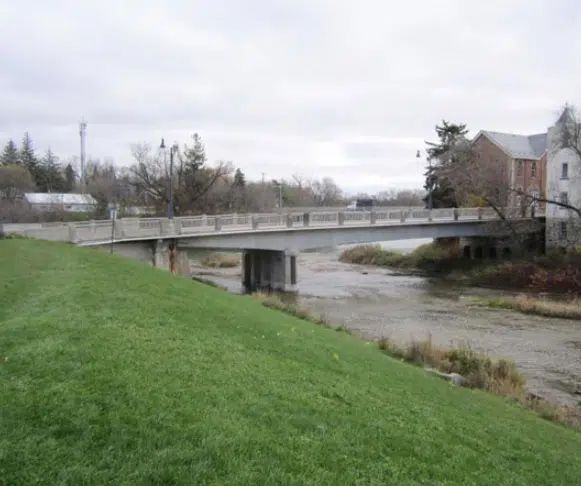
Bruce County Council will look at options presented by staff Thursday (Oct 28) to possibly reduce a projected $6.1 million in interest payments for bridge work loans.
A budget presentation earlier this month to the Corporate Services Committee heard from staff that in order to pay for three necessary bridge projects, the County is, and may continue to be taking on long-term debt.
It would need to borrow about $13 million to do the Teeswater Bridge in Paisley and the Durham Street Bridge in Walkerton.
According to a staff report on the agenda for Thursday, $830,000 in interest is already committed to pay off the 2018 reconstruction of the Oswald Bridge in Chesley. Staff anticipate the County will need to borrow $13 million to do the Teeswater Bridge in Paisley (2021-2024) and the Durham Street Bridge in Walkerton (2024-2026).
All that would come with as much as $6 million in interest payments.
Staff say one way to avoid that is to create an Infrastructure Renewal Capital Levy. Depending on the levy, the County can either avoid part of the debt, or all of it. According to the report in the October 28th agenda for the Corporate Services Committee, a 1.5 per cent annual levy from 2022 to 2026 put into a reserve would completely eliminate the interest payments.
An October 14th staff report says the adoption of the County’s existing infrastructure deficit arises out of past councils’ decisions not to heed a 2016 Asset Management Plan recommendation to put $4.2 million into reserves annually.
The presentation says, “Funds were not set aside in prior years due to desire to manage levy increases.”
It continues, “Predictable annual reserve contributions reduces major ups and downs in levies and saves over $6 million in interest payments.”
Director of Corporate Services Edward Henley says, “If from 2017, $1.6 million had been set aside each year in a bridge reserve, then that would have been enough to cover the amount we would otherwise be borrowing.”
He explains, “The desire is to keep taxes as low as possible, but unfortunately, it doesn’t look to future needs of these large expenses.”
County Warden and South Bruce Peninsula Mayor Janice Jackson says, “You get to the point where, as you keep putting projects off at some point, down the road– beyond our time, you’re going to hit a brick wall and you’re going to have all these projects that you’ve postponed because you didn’t want to raise the levy past a certain point. Before you know it, five years, seven years down the road, you’re facing a major problem. It’s not something we want to put on future councils and our taxpayers, you know, in five years from now.”
She adds, “It’s a balancing act and it’s a very difficult one. But we’ve got a terrific Treasurer and we’ve got a really skilled Director of Transportation and I think between all of us we’re going to find something that we can all swallow.”
Meanwhile, the proposed $123.5 million draft 2022 budget has $99.5 million earmarked for operating expenses and $24 million for capital expenses. It is proposed this would be achieved with a 4.8 per cent increase in tax rates.
Some key projects to be considered for 2022 include a new Bruce County paramedic station on Concession 10 in Port Elgin (to replace an aging existing one on Green Street), a clean energy vehicle strategy, a new bridge in Paisley, affordable housing, long-term care improvements and a library bookmobile.
A release from the County says the 2022 draft budget maintains core services and plans for the future with investment in affordable housing, transit, and growth.
Other focus points for the budget include cyber security initiatives, increased spending on traffic calming initiatives and transit.
Thursday’s meeting begins at 9 a.m.