


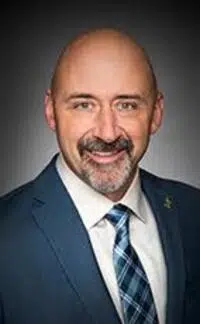
“We were only sitting there for a couple of weeks before the Christmas constituency break,” says Ruff noting, when the house resumed in January, there was a lot to learn. He was also named to the Veteran’s Affairs Committee for a period of time, where he advocated for reducing the backlog on veterans disability benefit claims that number in the tens of thousands.
The announcement of the resignation of Andrew Scheer created a leadership race which Ruff says kept a number of MPs busy in the new year once they decided who they were supporting, “As everybody knows, I supported our new leader Erin O’Toole right from the get go,” says Ruff, who has known O’Toole since they both attended the Royal Military College in the 1990s.
The COVID-19 pandemic hit, locking down the country in March and significantly limiting the number of MPs in the House for safety reasons, which Ruff says, “Threw everything into a bit of a loop where we were doing this virtual sort of special committee. It wasn’t real Parliament, but we kept that going and obviously the focus there was on how do you make sure the best legislation was passed.”
He says since the fall, the House of Commons has been, “Back to that sort of full, normal process of parliament with the ability for all of the MPs to participate in this hybrid fashion.”
In September, Ruff was appointed to Erin O’Toole’s leadership team as Deputy Conservative Party Whip, and says, “It’s been keeping me busy learning a lot more of the procedural aspects of how things run in the House of Commons.”
Since his first question in the House of Commons as MP on Dec 12th 2019, Ruff has been asking why, after Canada had to wait 11 years, the federal government missed the application deadline for the cattle industry to be taken off the world BSE Controlled Risk list (Bovine Spongiform Encepholopathy). Canada has been cut off from various beef markets around the world because it is on the list.
Ruff asked the government, what measures were put in place to ensure future deadlines will not be missed. He says the Ministry of Agriculture’s answer in November of “All stakeholders work constructively together,” is not a sufficient answer in his view. Ruff says he wants to understand why the chance to apply was missed, adding, “If it was due to anything that the government can control, have we fixed it?” He says, “It’s not about fault, It’s about making sure we’re prepared to do it again.”
He has also been pressing the government for a definition for the 1,500 firearm models the Federal Liberal Government banned under the description of ‘military assault firearms’ this past May, but Ruff says he hasn’t gotten what he feels is a clear answer to that question.
In November of 2020, the Federal Government responded to Ruff’s request for a definition of a ‘military style assault firearm,” answering it banned the firearms saying they are not ‘reasonable for hunting or sporting purposes” based on the following principles: (1) “semi-automatic function with sustain rapid-fire capability (tactical/ military design with large magazine capacity), (2) modern design, and (3) are present in large volumes in the Canadian market. It included firearms with 20 mm or greater bore size and muzzle energy over 10,000 joules.
Looking ahead to 2021, he says, “I can pretty much guarantee I’m still going to submit another firearms related question and I am definitely going to submit another ag question as well with BSE because, again, very frustrating when they refuse to answer a very simple question.” He says, “I’m not going to stop asking these questions until I get answers.”
While Opposition MPs continue to demand greater detail from the Federal Liberals on COVID-19 vaccine rollout timelines and quantities, the pandemic is not over yet.
Asked the govt when & where do they define “assault-style firearms?” Response: No date & points to a rpt (https://t.co/Dc9SaM1zOE) that highlights the need to define the term (but doesn’t) & that majority of respondents oppose a ban. #Answerthequestions @SSAOwenSound @CCFR_CCDAF pic.twitter.com/QSPsnlZOf8
— Alex Ruff (@AlexRuff17) November 17, 2020
Asked the govt: why they missed applying to change Canada’s BSE status to ‘Negligible Risk” in July 2019 & what measures have been put in place to ensure future deadlines aren’t missed? The answers: the govt applied in July 2020 & we worked constructively??? @BruceFed @GreyFedAg https://t.co/0dPOUKqGPP pic.twitter.com/ejs9rZ2zdh
— Alex Ruff (@AlexRuff17) November 17, 2020